
Introduction
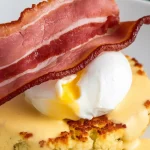
Eggs Benedict is the ultimate brunch centerpiece, offering a luxurious combination of crispy English muffins, savory meat, perfectly poached eggs, and a velvety blanket of hollandaise sauce. Mastering this dish lets you bring restaurant-quality elegance right to your kitchen table. With a bit of timing and technique, you can create this classic that’s sure to impress.
Prep & Cook Time
Prep Time: 10 minutes
Cook Time: 20 minutes
Total Time: 30 minutes
Servings: 4
Ingredients
- 4 slices of Canadian bacon (or 8 slices bacon)
- 4 large eggs
- 2 teaspoons white vinegar
- 2 English muffins
- Salted butter
- 2 tablespoons chopped parsley (for garnish)
- 10 tablespoons unsalted butter (melted)
- 3 large egg yolks
- 1 tablespoon lemon juice
- 1/2 teaspoon salt
- Dash of cayenne pepper or tabasco
Instructions
- Make the Hollandaise Sauce: In a heatproof bowl placed over a pot of gently simmering water (double boiler), whisk the 3 egg yolks, lemon juice, salt, and cayenne/tabasco until thickened and doubled in volume, about 3-4 minutes. Slowly drizzle in the 10 tablespoons of melted unsalted butter while whisking constantly, until the sauce is thick and creamy. Remove from heat, cover, and keep in a warm place.
- Poach the Eggs: Fill a large saucepan with water, add the 2 teaspoons white vinegar, and bring to a gentle simmer. Crack each of the 4 large eggs into a small cup. Stir the simmering water to create a whirlpool and gently slide each egg into the center. Cook for 3-4 minutes for runny yolks. Remove with a slotted spoon and drain on a paper towel.
- Cook the Meat & Toast Muffins: While eggs poach, cook the 4 slices of Canadian bacon (or 8 slices of regular bacon) in a skillet until heated through and lightly browned. Split and toast the 2 English muffins until golden. Spread the toasted muffin halves with salted butter.
- Assemble: Place two toasted muffin halves on each plate. Top each half with a slice of Canadian bacon (or two slices of regular bacon). Carefully place one poached egg on each bacon-topped muffin.
- Serve: Spoon the warm hollandaise sauce generously over each egg. Garnish with the 2 tablespoons of chopped parsley and serve immediately.
Variations
- Florentine Style: Replace the Canadian bacon with a small handful of sautéed fresh spinach for a vegetarian twist.
- Crab Cake Benedict: Use a small, warm crab cake in place of the Canadian bacon for a decadent seafood version.
- Avocado Benedict: Add a few slices of fresh avocado between the toasted muffin and the bacon for a creamy, modern touch.
- Muffin Swap: Instead of English muffins, try serving the components on toasted sourdough bread or a crispy hash brown patty.
Tips for Success
- For the best hollandaise, ensure your melted butter is still warm (but not hot) when drizzling, and whisk constantly to prevent the eggs from scrambling.
- The vinegar in the poaching water helps the egg whites coagulate faster, resulting in a neater poached egg.
- To keep everything warm while you assemble, heat your serving plates and place the cooked components (except eggs) in a low-temperature oven.
- If your hollandaise gets too thick, whisk in a teaspoon of warm water to thin it to the desired consistency.
Storage & Reheating
FAQ
Can I make the hollandaise sauce ahead of time?
It’s best made fresh, as it can separate upon reheating. If necessary, keep it warm in a thermos for up to an hour.
What if my hollandaise sauce breaks or curdles?
Remove it from heat and whisk in 1-2 tablespoons of hot water, one at a time, until it comes back together.
Can I poach the eggs in advance?
Yes. Poach them as directed, then transfer them to a bowl of ice water. Store in the fridge for up to a day. Reheat by placing them in hot water for 1 minute.
I don’t have a double boiler. How can I make the sauce?
Use a heatproof bowl that fits snugly on top of a small saucepan. Ensure the simmering water in the pan does not touch the bottom of the bowl.
What can I use instead of Canadian bacon?
The recipe suggests 8 slices of regular bacon as a direct substitution. You can also use thinly sliced ham or prosciutto.
Why do I add vinegar to the poaching water?
The vinegar helps the egg whites coagulate more quickly, resulting in a tighter, neater poached egg with less wispy white.